

One of the questions plaguing polymer enthusiasts and professionals alike is: which material and process will lead to the next phase of plastic evolution? While many believe Bioplastics, a type of plastic made from renewable biological matter rather than petroleum, will lead the next phase of plastic evolution, the jury is still out on the best plastic manufacturing process for both industrial and consumer goods.
Eco-friendly manufacturers, investors, and consumers looking to discover ideal ways to produce and consume plastics in the future will find this article helpful. We’ll explore the evolution of plastic production, types of plastic materials, industrial uses of plastics, and the difference between injection molding and additive manufacturing in plastic production.
Plastic Manufacturing Evolution: How Did Plastic Become a Global Phenomenon?
Plastic manufacturing dates as far back as the late 1800s. Alexander Parkes, a metallurgist from London, invented the first artificial plastic material, Parkesine, in 1862 as a transparent, lightweight, high-impact alternative to glass plates used by photographers for photosensitive emulsions. He presented his invention at the Great International Exposition in South Kensington, London.
Parkes patented the Parkesine in 1885. His Parkesine was formed by dissolving cellulose nitrate in camphor and alcohol, which contained ether. His invention was such that the transparent polymer compound could be molded at a heated temperature and subsequently assume a solid form when it cooled off. Even though he received applause from industrial leaders and enthusiasts, he couldn’t capitalize on his invention, as it was highly flammable and expensive to produce.
Daniel Spill, who was Parkes’s assistant, started manufacturing nitrocellulose in 1869, which he called Xylonite. However, this product was also a commercial failure. In 1872, John Wesley and Isaiah Hyatt created a variation of the Parkesine, called Celluloid, from a mixture of soluble cotton, alcohol, and camphor, as a substitute for ivory in billiard balls. Their product enjoyed commercial success. Photographers in Europe began experimenting with celluloid but soon complained it was too thick and sticky for photography.
By 1888, thin celluloid sheets flexible enough to be used as negatives for photography became available. In 1903, German scientists—Arthur Eichengrün and Theodore Becker—used Paul Schützenberger’s discovery to make the first soluble forms of cellulose acetate. By 1907, Leo Baekeland invented Bakelite—the first fully synthetic plastic containing zero molecules of natural polymer—as a substitute for shellac, a natural electrical insulator.
In 1908, Jacques E. Brandenberger invented Cellophane as a transparent, flexible, waterproof film to prevent tablecloths from absorbing liquids. Between 1920 and 1939, polyvinyl chloride, plexiglass, and nylon were invented. After World War II, heavyweight plastics such as ABS and polycarbonate were introduced. Today, there is a host of plastic materials yet to be exploited.
What Are the Types of Plastic Materials?
Plastics are made from polymer resins. These malleable materials possess features that allow them to be molded and shaped at certain elevated temperatures and solidified upon cooling, to suit a variety of man-made applications. However, plastics fall into two categories: thermosets and thermoplastics.
While the former has cross-linked molecular chains and is irreversible—meaning once molded and shaped cannot be reshaped or remolded—the latter has linear molecular chains and reverse elasticity. Most thermoplastics have a high molecular weight, can withstand high temperatures, are flexible, and resistant to impact.
Some of the most popular plastics include:
● Polyethylene: This popular thermoplastic polymer has a crystalline structure, made from a monomer with a double bond. It comprises several polymerized ethylene molecules. This synthetic resin from the polyolefin family is the most demanded thermoplastic in the world. In 2022, the market volume for thermoplastic polyethylene was almost 110.13 million metric tons worldwide. It is projected to reach 135.08 million metric tons by 2030. Polyethylene is used for plastic bottles and containers for consumer goods, making construction pipes, and heating and drainage systems.
● Polypropylene: Polypropylene which also belongs to the family of polyolefin resins is a thermoplastic polymer that is semi-crystalline and nine-polar. This synthetic resin is made from polymerized propylene gas. Like polyethylene, it is made from molecules with a single pair of carbon atoms with a double bond. Polypropylene is used in the fiber and textile industry, packaging, machinery, and automotive parts. It is the second most produced thermoplastic. In 2022, Statista noted that 79.01 million metric tons of polypropylene were produced. It may amount to 104.99 million by 2030.
● Polyamides: This is a synthetic polymer that comprises monomers linked together by amide groups in repeating units. Polyamides are made from polymerized amino acids containing both amine and carboxyl groups. The most popular polyamide is nylon. Nylon is a lightweight, elastic synthetic polymer that contains natural proteins and peptides. Polyamides are used to produce kitchen utensils, food packaging, carpets, combs, brushes, textile fabrics, and parts in the automotive industry.
● Polystyrene: Polystyrene is a brittle, rigid transparent synthetic polymer that is made from the polymerization of styrene. Styrene is formed through the mixture of ethylene and dehydrogenated benzene in the presence of aluminum chloride. Polystyrene is used to produce disposable trays, food and beverage containers, blenders, air conditioners, microwaves, vacuum cleaners, and car parts.
● Polycarbonate: This is a transparent amorphous thermoplastic material with high impact resistance, optical clarity, dimensional features, and rigidity. It is made from the polymerization of bisphenol A and phosgene. It is used to make eyeglasses, compact discs, car headlamps and interiors, safety helmets, baby bottles, roofs, and windows.
● Polyvinyl Chloride: This insoluble synthetic polymer material is made from the polymerization of vinyl chloride monomer. Vinyl chloride is obtained from the interaction of oxygen, ethylene, and hydrogen chloride over a copper catalyst. It is used to make construction pipes, wires, cables, floor coverings, shower curtains, and medical devices.
● Acrylic: Acrylic, also called plexiglass, is a hard, rigid plastic with glass-like properties and high impact resistance. These multi-colored transparent polymer resins are derived from acrylic and methacrylic acids. Acrylics are used to make beauty nails, paints, LCD screens, medical devices, aquariums, and protective panels.
● Acrylonitrile Butadiene Styrene (ABS): This amorphous polymer is a styrene-acrylonitrile copolymer modified with butadiene rubber. It is brittle and has a high heat resistance. ABS is used to produce protective head gears, pipes, vehicle interiors, and house appliances.
● Polyethylene Terephthalate: This is also a solid and rigid synthetic resin from the polyester family made from the polymerization of ethylene glycol and terephthalic acid. Manufacturers use it in food and beverage packaging, wall insulation, and fabric making.
Injection Molding vs Additive Manufacturing: Which Plastic Manufacturing Process is King?

Injection molding and additive manufacturing techniques are at both ends of a continuum. While one uses a subtractive manufacturing process to create objects, the other uses an additive mechanism to achieve finished products.
We’ve outlined the core difference between these complementary manufacturing processes and their top benefits.
What is Injection Molding?
Injection molding is a popular subtractive manufacturing process that allows you to inject heated molten materials, some of which include metals, glasses, and polymer fibers, into constructed mold cavities to produce and assemble identical parts of an item in large quantities without color, weight, or dimensional variations in quality.
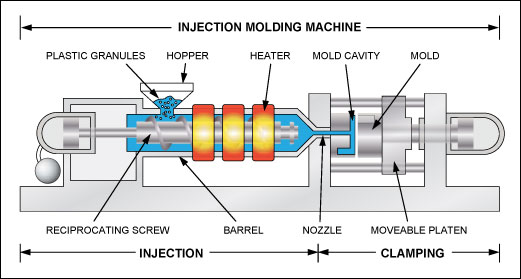
Today, injection molding machines and techniques are used to mass-produce several complex designs across customer goods, construction, automobile, defense, and aerospace industries.
What is Additive Manufacturing?
Additive manufacturing, also called 3D printing, is an industrial manufacturing method that allows you to transform digital three-dimensional models into physical objects by adding definitive layers of materials to a base layer framework.
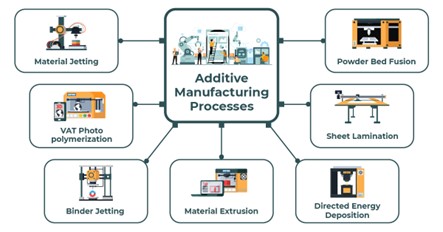
The process often starts with creating a computer-aided design using CAD software or scanning a paper design which will then be constructed into a layer-based framework before being sent to a 3D printer to sinter and mill the parts of the object together. This technique has been used to produce. The process may take hours or days to complete.
Comparing the Injection Molding and Additive Manufacturing Methods: Design, Process, Materials, and Applications
|
|
Core Areas |
Injection Molding |
Additive Manufacturing (AM) |
|
|
Engineering Design: |
The injection molding design process starts when the design engineer develops the ideal product based on core user specifications through manual drafting or specialty design tools |
A Design engineer designs and tests 3D models of complex geometric shapes for real-world applications using CAD and simulation modeling software. Afterward, they convert their designs into a series of instructions for the AM hardware. |
|
|
Production Process: |
This direct manufacturing process comprises seven steps: molding, clamping, injection, cooling, ejection, and decoration. A mold is secured in the clamping unit, then a heated and pressurized molten material from a heated barrel is injected into it and mixed with a screw. After a few seconds, the material in the mold is fed into the mold cavity where it hardens as it cools off. Once ejected, post-production designs can be applied to the object. |
This printing process involves fusing layers of powdered materials with a layer of binding liquid using seven printing processes. These digital manufacturing processes include material jetting, directed energy deposition, powder bed fusion, sheet lamination, binder jetting, vat photopolymerization, and material extrusion. |
|
|
Production Materials: |
In injection molding, molds are made from rubber, copper, plastic, concrete, wax, metal, steel, or any other durable material. Molten materials used in creating the final products can include nylon, high-density polyethylene, acrylonitrile butadiene styrene (ABS), polycarbonate, high-impact polystyrene, acrylic, silicone, rare metals, and glass. |
Additive manufacturing is ideal for fusing intricate and lightweight materials, including polymers, ceramics, lattices, composites, and metals. |
|
|
Industrial Applications: |
Injection molding is used to make automotive parts, medical devices, packaging for pharmaceuticals and consumer goods, telecommunications and electronic components, furniture fittings and ornaments, transportation, construction, and agricultural products. |
Some of the industries where additive manufacturing is used include oil and gas, space, biomedical, defense, construction, aerospace, automotive, energy, consumer goods, energy, sports, and pharmaceuticals. |
Benefits of Injection Molding Manufacturing
● Ideal for high production: The injection molding process allows manufacturers to produce large volumes of items with little or no color, design, or weight variations.
● Once the mold has been made, producing single items in large quantities once the mold is done is fast, repeatable, and affordable, thus allowing you to maximize production efficiency.
● Injection molding is ideal for heavyweight or complex materials: Injection molding is used to produce items from a broad range of single or multiple raw materials, including heavyweight materials such as polycarbonate, silicones, high-density polyethylene, and rare metals like tungsten and aluminum.
● Injection molding encourages the reuse of leftover materials. While the production process may lead to high material waste, manufacturers can remelt or reuse post-production scraps to produce new items.
● Low labor costs: injection molding allows manufacturers and investors to cut down on the cost of hiring workers as most of the processes are automated and achieved with machine parts.
Benefits of Additive Manufacturing
● Reduced material waste: Injection molding and many other production processes subtract from a sizable chunk of raw materials to carve out its final product. However, additive manufacturing does the opposite. It builds products by adding layers of raw materials to a base layer.
● Lower start-up cost of production: The capital requirement for producing a single unit or batch of products in additive manufacturing is significantly less than in other plastic production processes. For one, it eliminates the need to create custom tooling equipment for every new design. Also, industrial machinery for 3D printing is more affordable than injection molding machines.
● Rapid prototyping: 3D printing machinery and software make it easier to render models and automate design/production processes for a single item—without worrying about setup costs or processes—reducing the production time and encouraging product adjustments or retrials.
● Flexible customization: Since additive manufacturing uses computer-aided design (CAD) software to create 3D models before physical production, manufacturers can customize each item in a batch to suit the design requirements. Occasionally, the molds can be reshaped and reused if errors occur during printing.
● Additive manufacturing is best for producing complex designs and manipulating delicate or lightweight materials, such as ceramic fibers, micro lattices, bio-sourced polymers, and honeycomb materials.
The Future of Plastics: Should I Invest in Plastic Production?
Yes, you should. As a business leader and investor in the construction, aerospace, defense, medical/pharmaceutical, and consumer goods industries, investing in plastic manufacturing will allow you to capitalize on years of excellent market growth and mouth-watering profit returns. Plastics are still a key facilitator of industrialization.
Even though its evolution is fraught with layers of pellet-sized controversies, It’s no secret that the market demand for plastic products continues to soar. In 2023, Statista’s data analysis revealed that the plastic market value will grow at a 4.0% CAGR, from $712 billion to $1,050 billion, between 2023 and 2033.
A global report from Grand View Research showed that packaging, construction, consumer goods, and automotive held the highest revenue share in 2022. The report also revealed that injection molding is still the most dominant processing method for plastic production, having about 43.38% of the market share.
Conclusion
At PTI Tech, we will listen, understand, and provide innovative and value-added solutions to injection molding and tooling problems across operations that span aerospace, construction, defense, medical, and industrial sectors in the United States. Leveraging over 36 years of manufacturing experience, PTI Tech is an industry leader in polymer injection molding, metal injection molding, tungsten injection molding, and specialty tooling.
Employing the latest technological advancements in additive manufacturing (AM), we help our clients streamline their design and manufacturing processes to optimize the potential of their final product. Our AM capabilities at Hawk Ridge Systems include SolidWorks best practices and solutions; 3D product design and engineering; cloud computing, 3D manufacturing, and; business and IT support to meet your specific needs.
Are you ready to launch a profitable partnership? Get in touch with us today!