
Plastic wasn’t always mainstream. In fact, as far back as the early 1800s, before Charles Goodyear even invented and patented vulcanized rubber and Alexander Parkes began exploring the potentials of cellulose nitrate in creating man-made plastic material, traditional manufacturers relied on ivory to make a variety of items, including figurines, ornaments, and carvings.
As you’ve probably guessed, ivory had a lot of drawbacks. For starters, ivory was rare, expensive, heavy, and rigid. The advent of injection molding paved the way for industrial growth at all levels, all thanks to a few notable men. If you’re new to injection molding and would like to understand what all the hype is about, then get comfortable. This article details the history, meaning, types, processes, and factors to consider in injection molding.
What is Injection Molding?
Injection molding is a manufacturing process that allows you to inject heated molten materials, such as metals, glasses, and most commonly polymer, into mold cavities to produce identical parts of an item in large quantities without variation in quality. The advancement of injection molding machines and techniques led to the mass production of several complex products, including electronics, automobiles, furniture, home appliances, and medical devices.
Brief History of Plastic and Injection Molding: Who is the Father of Injection Molding?
The first injection molding machine was invented and patented by two brothers, John and Isaiah Hyatt, in November 1872. These American inventors, John Wesley Hyatt, and Isaiah Smith Hyatt received global recognition for inventing the celluloid machine and the process for making celluloid—the first synthetic thermoplastic—from a mixture of soluble cotton, alcohol, and camphor, as a substitute for ivory in billiard balls.
It was a variation of Alexander Parkes’s invention, “Parkesine.” John Wesley, a printer, was moved to creating this invention after seeing a New York ad promising a cash prize of $10,000 to anyone who could devise a substitute for ivory billiard balls. Although he never received the $10,000 award, this invention became a global sensation as more inventors began to explore other ways to produce inexpensive yet durable synthetic materials to foster industrialization.
By 1903, using the discovery of Paul Schützenberger, two German scientists—Arthur Eichengrün and Theodore Becker—improved the process of making thermoplastic polymers by introducing the first soluble forms of cellulose acetate. In 1907, Leo Baekeland invented Bakelite—the first fully synthetic plastic containing zero molecules of natural polymer—as a substitute for shellac, a natural electrical insulator.
From 1945, the demand for inexpensive plastic materials grew with the need to preserve dwindling natural resources. During this period, thermoplastic materials such as Nylons, Polyvinyl chloride, Plexiglas, Polyolefins, and Polystyrene were invented. By 1946, James Watson Hendry had created the extrusion screw injection machine. This invention revolutionized modern injection molding. Plastic soon became a substitute for glass and metals as it could produce cheaper and lighter items.
However, by the 1970s, it became evident that plastic was not the savior people thought it was. The massive environmental pollution caused by plastic led to the industry introducing recycling as a solution.
The Injection Molding Process: How Does Injection Molding Work?
Several factors can make or break the injection molding process. For starters, the injection position, the melt, barrel, nozzle temperatures, melting, cooling, ejecting speed, product materials, and screw-back pressure are only a few factors to consider during the injection molding process.
- Molding: The injection molding process starts when the mold is created by the mold maker and precision machined to align with the product design requirements. The mold may be made from rubber, plaster, concrete, wax, metal, steel, or any other durable material.
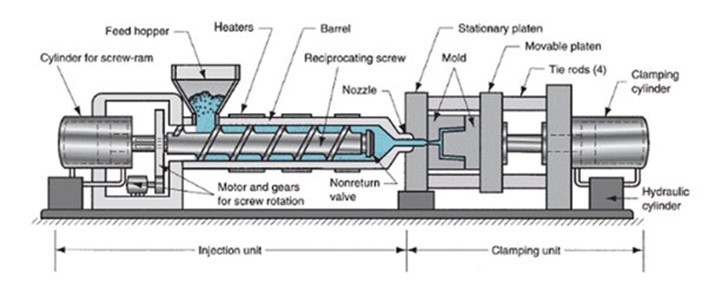
- Clamping: The next step in the Injection molding is for the two halves of the mold to be firmly secured in the clamping unit.
- Injection: Once done, the machine injects a heated and pressurized molten material from the heated barrel into the mold through the nozzle. This material is usually anything malleable, like polymer (plastic or elastomer), metal, or glass. It will then be mixed using the screw.
- Cooling: During this phase, the material in the mold is fed into the mold cavity where it takes on a definite solid form as it cools off. The mold cavity cannot be opened until the cooling phase is complete. The length of this phase depends on the dynamics of the material.
- Ejection: Every injection molding machine comprises an ejection system that opens, pushes, and closes the formed parts after it has cooled off.
- Decoration: the material may also be subjected to further designs—trimming, painting, and marking— based on the manufacturer’s needs.
Factors To Consider When Using Injection Molding Technology? Types & Benefits of Injection Molding

Companies looking to invest in this complex technology must consider factors such as the cost of injection molding machines, production quality and quantity, and the experience of designers, to name a few.
We’ve highlighted some types and benefits of modern injection molding technology every prospective manufacturer should know.
Types of Injection Molding Technology
While there are several types of injection molding technology, depending on the material and process used, we’ve highlighted some of the most popular to get you started.
- Gas-assisted Injection Molding: This low-pressure plastic molding process involves injecting pressurized nitrogen gas into a mold cavity containing the solid molten material.
- Compression Molding: In this process, the pre-heated raw polymer resins are directly injected into the open heated mold cavity to be softened by the heat.
- Die Casting: This metal casting method involves injecting molten metal into a mold under high pressure and speed to produce precise metal parts.
- Liquid Silicone Injection Molding: Liquid silicone injection molding is a thermosetting fabrication process of injecting liquid silicone rubber (LSR) compound mixed at room temperature into a heated mold tool made through CNC machining. Once molded, the LSR process is irreversible.
- Thin Wall Molding: This conventional process is used to create small, lightweight, and complex plastic parts. These parts often have a wall thickness of less than 1mm.
- Metal Injection Molding (MIM): Sometimes confused with powder metallurgy, MIM is a metalworking process that involves creating metal parts by combining a blended metal powder with polymer binders and injecting the solution into a heated molding machine at high temperatures.
Benefits of Using Injection Molding Technology
● Injection molding allows you to reduce material waste, thus preserving nature.
● This complex technology allows manufacturers to produce large volumes of parts at cheaper rates.
● Engineers and designers may enjoy the ease of implementing complex product designs.
● The process is fast and can be repeated as many as needed on a broad range of materials.
Is Injection Molding Cost-Effective?
Injection molding is the most efficient way to mass-produce identical parts on a budget. Although the initial cost of acquiring and setting up the technology and team is high, you’ll recoup their losses and multiply your gains in the long run. However, if you can’t bear this risk currently, you can outsource your manufacturing needs to a design and engineering firm.
Is Injection Molding Worth It?
Yes, it is. If you’re a manufacturer weighing the pros and cons of investing in injection molding, it might interest you to know the global injection molding market will surpass $397.6 billion by 2030. According to recent findings by Statista, consumer demand for molded polypropylene plastics in the United States is set to reach 11.5 million tons by 2025. In Europe, Polypropylene and Polyethylene also hold the largest share of consumer demand for injection molded plastics.
Conclusion
At PTI Tech, we will listen, understand, and deliver innovative and value-added solutions for operations that cut across aerospace, defense, and industrial production. We aim to form lasting partnerships with our clients by providing proactive and creative responses to ever-changing industry trends to keep our clients ahead.
Are you ready to launch a profitable partnership? Contact us today!