

In 2022, a team at the U.S. Army Combat Capabilities Development Command’s Army Research Laboratory made a significant breakthrough in additive manufacturing quality control. They developed an AI system capable of detecting microscopic cracks in 3D-printed metal parts with 85% accuracy, identifying defects as small as 50 micrometers—about half the width of a human hair.
The system works by capturing multiple high-resolution images of a part from different angles. These images are then processed by a convolutional neural network trained on thousands of examples of both flawed and flawless parts. The AI not only identifies defects but also classifies them, distinguishing between different types of imperfections such as pores, cracks, and lack of fusion errors.
This advancement isn’t just about catching flaws—it’s about understanding them. By analyzing patterns in the defects it detects, the AI system can provide insights into the manufacturing process itself, suggesting adjustments to printing parameters that could prevent future defects. This proactive approach to quality control has the potential to significantly reduce waste and improve the overall reliability of 3D-printed components in military equipment.
The AI Revolution in Defense Manufacturing
At Lockheed Martin’s F-35 production facility, an AI system dubbed “Project CAPTAIN” (Cognitive Augmentation for Production Teams Artificial Intelligence Network) is transforming the manufacturing process. This system doesn’t just monitor production—it actively optimizes it.
Project CAPTAIN analyzes data from hundreds of sensors across the production line, tracking everything from tool wear to environmental conditions. It then uses this data to predict potential issues and suggest proactive solutions. For example, if the system detects that a particular tool is wearing faster than usual, it can automatically adjust the machining parameters to compensate, or signal for the tool to be replaced before it causes quality issues.
The system also optimizes workflow by predicting bottlenecks and suggesting real-time adjustments to production schedules. This has allowed Lockheed Martin to reduce the time it takes to produce an F-35 by nearly 40% since the system’s implementation in 2019.
AI-Powered Quality Control: A New Era of Precision
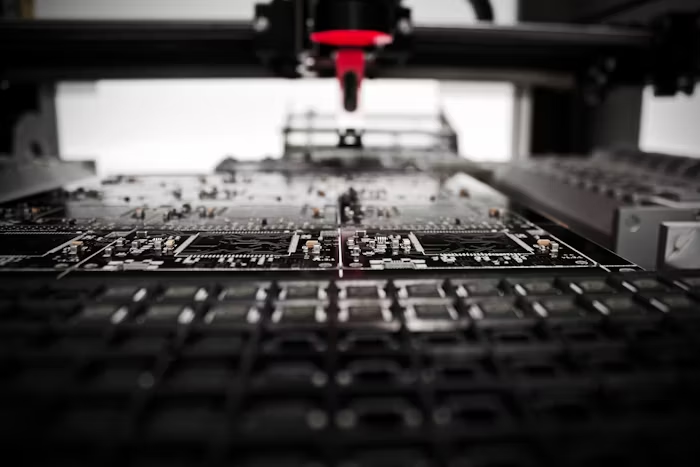
While Lockheed Martin’s AI system focuses on overall production optimization, BAE Systems has implemented a specialized AI for quality control in circuit board manufacturing. At their electronic warfare facility in New Hampshire, this advanced system takes a micro-level approach, monitoring over 50,000 data points during the production of each individual circuit board.
What sets this system apart is its focus on the chemical and environmental aspects of production. It tracks subtle variations in temperature, humidity, and even the chemical composition of solder paste—factors that can have a significant impact on the quality and longevity of electronic components in military hardware.
The AI doesn’t just passively monitor these factors; it actively learns from them. By analyzing patterns in the vast amount of data it collects, the system can identify potential problems before they occur and suggest preventative measures. This might involve adjusting the climate control in the facility, recommending a change in the solder paste composition, or flagging a batch of components that may be more prone to failure under certain conditions.
Mark Quinlan, Engineering Manager at BAE Systems, explains: “The AI doesn’t just tell us when something’s wrong. It tells us why it’s wrong and suggests corrective actions. It’s like having a team of expert chemists and environmental scientists watching every step of the production process 24/7.”
Optimizing Manufacturing Processes with AI
Beyond quality control, AI is also transforming how defense manufacturers design and optimize their production processes. At General Dynamics Land Systems, AI is being used to improve the efficiency of tank production.
The company has implemented a system that uses machine learning to optimize welding processes. By analyzing data from sensors monitoring factors like temperature, current, and arc stability, the AI can predict weld quality in real-time. If it detects conditions that might lead to a suboptimal weld, it can adjust parameters on-the-fly or alert operators to potential issues.
This system has not only improved weld quality but also reduced material waste by 15% and energy consumption by 20%. Furthermore, it’s allowing General Dynamics to push the boundaries of what’s possible in tank armor design. The AI’s ability to precisely control and monitor the welding process enables the creation of more intricate weld patterns. These complex patterns can include layered welds, varied weld depths, and strategically placed reinforcements that enhance the armor’s ability to dissipate energy from impacts, ultimately improving vehicle survivability.
The Human Element: AI as a Force Multiplier
While AI brings tremendous capabilities to defense manufacturing, it’s crucial to understand that it doesn’t replace human expertise—it enhances it. Skilled engineers and operators remain at the heart of the manufacturing process, with AI serving as a powerful tool that amplifies their capabilities.
Dr. Elena Rodriguez, a manufacturing systems expert at MIT, explains it this way: “AI in manufacturing isn’t about replacing humans with robots. It’s about creating a symbiosis between human intuition and machine precision. The AI can process vast amounts of data and identify patterns, but it’s the human engineers who interpret these insights and make strategic decisions.”
This symbiosis is evident in the way modern defense manufacturing facilities operate. AI systems provide real-time guidance to operators, suggesting optimal machine settings or flagging potential issues before they become problems. This not only improves efficiency but also enhances job satisfaction by allowing workers to focus on more challenging and rewarding aspects of their roles.
Challenges and Considerations in AI Implementation
While the benefits of AI in defense manufacturing are clear, implementing these systems isn’t without challenges. Data security is a primary concern, given the sensitive nature of defense manufacturing. Any AI system must be rigorously protected against potential breaches, often requiring the development of custom solutions that can operate in air-gapped environments.
The consequences of a security breach in this context could be severe. If an adversary were to gain access to the AI systems controlling defense manufacturing processes, they could potentially:
- Steal sensitive design information about cutting-edge military technology.
- Introduce subtle flaws into the manufacturing process, compromising the reliability of military equipment.
- Disrupt production schedules, affecting military readiness.
- Gain insights into production capabilities, providing valuable intelligence about military capacity.
To mitigate these risks, defense manufacturers are investing heavily in cybersecurity measures. This includes not only robust firewalls and encryption but also advanced intrusion detection systems and regular security audits. Some companies are even developing AI-powered cybersecurity systems to defend against AI-driven cyber attacks.
There are also ethical considerations to navigate. As AI systems become more autonomous, questions arise about accountability and decision-making. Who is responsible if an AI-driven manufacturing process produces a faulty component that leads to equipment failure in the field?
Additionally, there’s the risk of over-reliance on AI systems. While these tools are powerful, they’re not infallible. Maintaining human oversight and fostering a culture of critical thinking is crucial to ensure that AI remains a tool to enhance human capabilities, not replace them.
Looking Ahead: The Future of AI in Defense Manufacturing
As AI technology continues to evolve, its impact on defense manufacturing will only grow. We can expect to see more sophisticated simulation and modeling capabilities, allowing for virtual testing of components under extreme conditions. This could significantly reduce development times and costs while improving the reliability of new defense systems.
The integration of AI in defense manufacturing represents a significant leap forward in our ability to produce high-quality, precision-engineered components for military applications. By embracing these advanced technologies, manufacturers can ensure they remain at the cutting edge of defense production, delivering the high-performance, ultra-reliable components that our military relies on.
To learn more about how advanced manufacturing technologies are being applied in the defense sector, visit PTI Tech and Polmold for insights into cutting-edge molding and tooling solutions.