
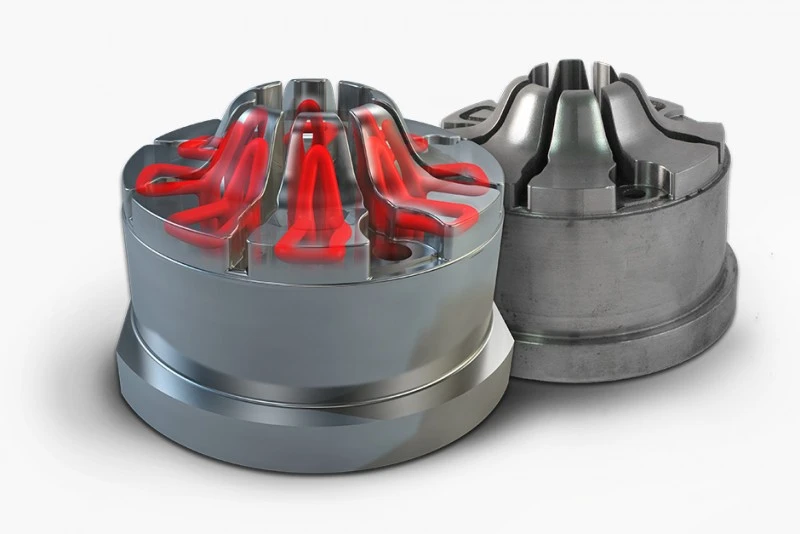
The injection molding industry is experiencing a transformation through conformal cooling technology. As manufacturers face increasing pressure to reduce costs, improve quality, and accelerate production timelines, traditional cooling methods are proving inadequate for modern manufacturing demands. Conformal cooling is an approach that uses 3D-printed tooling inserts to create sophisticated cooling channels that follow the contours of molded parts, delivering improvements in both cycle time and part quality.
Understanding Conformal Cooling Technology
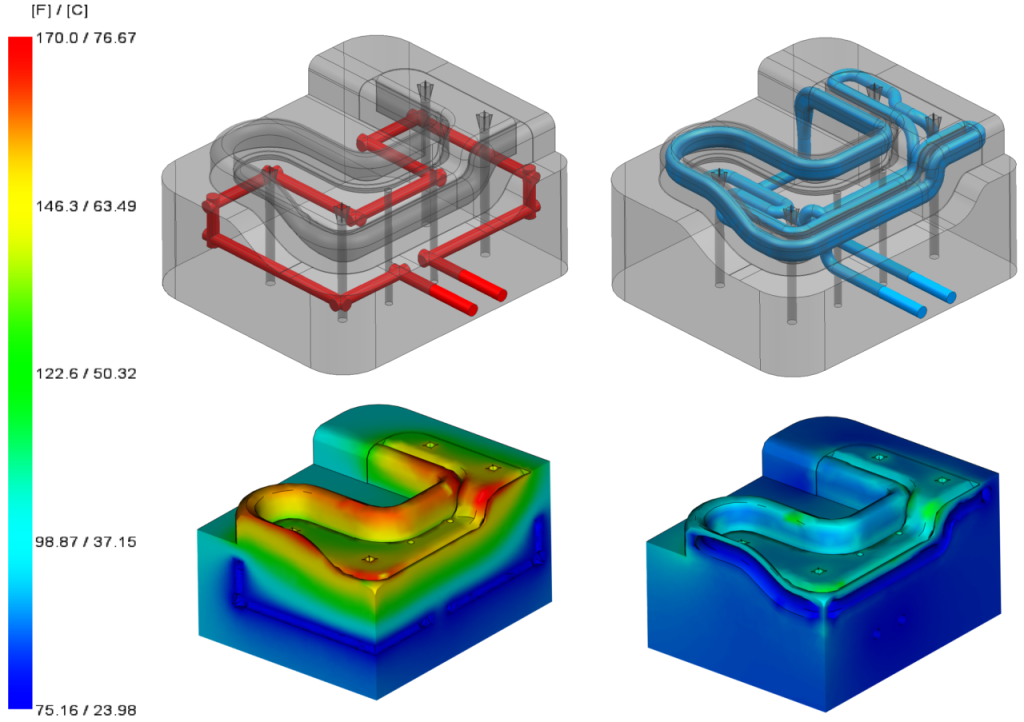
Conformal cooling is a departure from conventional cooling methods in injection molding. Traditional cooling systems rely on straight-drilled channels that follow the mold’s construction geometry. These linear channels often create uneven cooling patterns, leading to inconsistent part quality and extended cycle times. In contrast, conformal cooling channels are designed to follow the exact contours of the molded part, maintaining consistent wall thickness between the cooling channel and the part surface. This approach ensures uniform heat extraction throughout the entire part geometry, regardless of its complexity.
The technology is made possible through additive manufacturing, particularly metal 3D printing, which allows for the creation of complex internal geometries that aren’t possible to machine using traditional methods. By maintaining optimal proximity to all areas of the molded part, these channels provide more efficient heat transfer, reducing the temperature differential across the part. This uniform cooling eliminates hot spots that can cause warpage, sink marks, and other quality defects while significantly reducing the time required for parts to solidify and cool to ejection temperature.
The 3D Printing Revolution in Tooling
Metal additive manufacturing has been the catalyst that transformed conformal cooling from a theoretical concept into a practical manufacturing solution. Technologies such as Direct Metal Laser Sintering (DMLS) and Selective Laser Melting (SLM) enable the production of complex cooling channel geometries within mold inserts that were previously impossible to create.
These 3D printing technologies work by selectively melting metal powder layer by layer, building up the complete mold insert with its integrated cooling channels. The process enables the creation of channels that can branch, merge, spiral, and follow any three-dimensional path required to optimize cooling efficiency. This design freedom enables engineers to create cooling systems that are perfectly tailored to each specific part geometry.
The materials used in 3D-printed tooling inserts have evolved, with high-performance tool steels and specialized alloys now available that provide excellent thermal conductivity while maintaining the durability required for high-volume production. These materials can withstand the thermal cycling and mechanical stresses of injection molding while providing superior heat transfer characteristics compared to traditional tool steels.
Dramatic Cycle Time Reductions
One of the most compelling benefits of conformal cooling is its ability to reduce cycle times. Research and real-world applications have demonstrated that conformal cooling can reduce cycle times from 10% to 40% compared to conventional cooling methods, with some optimized applications achieving even greater improvements. The mechanism behind these improvements lies in the enhanced heat transfer efficiency. Traditional cooling channels often leave areas of the part poorly cooled, requiring extended cooling times to ensure the entire part reaches ejection temperature. Conformal cooling eliminates these thermal bottlenecks by providing uniform cooling throughout the part geometry.
For manufacturers, cycle time reduction means increased productivity and profitability. In high-volume production environments, even a modest cycle time reduction can result in an increase in cost savings and capacity. The cooling phase typically represents 60% to 80% of the total injection molding cycle time, making it the most significant opportunity for improvement. By optimizing this phase through conformal cooling, manufacturers can achieve the most impactful reductions in overall cycle time.
Enhanced Part Quality and Consistency
Beyond cycle time improvements, conformal cooling delivers significant enhancements in part quality and consistency. The uniform cooling provided by conformal channels addresses many of the quality issues that plague injection molding operations, including warpage, sink marks, differential shrinkage, and dimensional inconsistencies.
Warpage is one of the most common quality issues in injection molding, caused by uneven cooling that creates internal stresses within the part. Different areas of the part cool at different rates, leading to differential shrinkage that manifests as warpage once the part is ejected from the mold. Conformal cooling solves this problem by ensuring uniform cooling throughout the part geometry. Sink marks, another defect, occur when thicker sections of the part cool more slowly than surrounding areas, creating visible depressions on the part surface. The uniform cooling provided by conformal channels prevents these thermal imbalances, resulting in parts with superior surface quality and dimensional accuracy.
The improved thermal management leads to better material properties in the finished parts. More uniform cooling results in more consistent molecular orientation and crystallization patterns in the plastic, leading to parts with improved mechanical properties and reduced internal stresses. This is particularly important for high-performance applications where material consistency is critical.

Reducing Scrap and Waste
Manufacturing efficiency is not just about speed; it’s also about quality and waste reduction. Conformal cooling technology reduces scrap rates by improving part quality and consistency. Traditional cooling methods often result in parts that fail quality inspections due to warpage, dimensional variations, or surface defects.
By providing more uniform cooling, conformal cooling technology dramatically reduces the occurrence of these quality issues. Parts produced with conformal cooling exhibit better dimensional stability, reduced warpage, and superior surface finish. This improvement in first-pass quality reduces scrap rates, minimizes rework, and improves overall manufacturing efficiency. The reduction in scrap also has environmental benefits, as fewer rejected parts mean less material waste and lower overall resource consumption.
Implementation Considerations and Challenges
While the benefits of conformal cooling are substantial, successful implementation requires careful consideration of several factors. The initial investment in 3D-printed tooling inserts is typically higher than conventional machined inserts, requiring a thorough cost-benefit analysis to justify the investment. The design of conformal cooling channels requires specialized expertise and sophisticated simulation software to optimize channel geometry for maximum cooling efficiency. Engineers must consider factors like coolant flow rates, channel diameter, surface area, and thermal properties to create optimal cooling designs.
Manufacturing lead times for 3D-printed inserts can be longer than traditional machining methods, requiring careful planning and scheduling. However, the design flexibility offered by additive manufacturing often allows for design improvements that would be impossible with conventional methods, potentially offsetting the additional lead time. Quality control and validation are critical aspects of implementing conformal cooling technology. The complex internal geometries must be thoroughly tested to ensure proper coolant flow and heat transfer performance.
Future Outlook and Emerging Trends
Conformal cooling technology keeps improving, with developments in materials, manufacturing processes, and design optimization techniques. Advanced simulation software is becoming more sophisticated, enabling engineers to optimize cooling channel designs with greater precision and efficiency.
New materials specifically designed for 3D-printed tooling applications are being developed, offering improved thermal conductivity, durability, and surface finish. The integration of sensors and monitoring systems into 3D-printed tooling inserts is an emerging trend that will enable real-time monitoring of cooling performance and predictive maintenance. This connectivity will provide data for optimizing cooling performance and preventing quality issues before they occur.
As additive manufacturing technology continues to advance and costs decrease, conformal cooling will become accessible to a broader range of manufacturers, from large-scale production facilities to smaller, specialized operations. Conformal cooling represents a transformative technology that addresses two of the most critical challenges in injection molding: cycle time and part quality. Conformal cooling can reduce cycle times by 10-40%, improve part quality, reduce scrap rates, and enhance overall manufacturing efficiency. Connect with PTI to learn more about how we use conformal cooling technology in injection molding applications for your needs.
References
- Metal-AM. (2025, January 27). “Conformal cooling: How Additive Manufacturing benefits injection moulding.” Retrieved from https://www.metal-am.com/articles/how-3d-printing-is-increasing-efficiency-and-quality-in-the-injection-moulding-industry/
- SyBridge Technologies. (2024, January 25). “Conformal Cooling: Higher-Quality Parts, Faster Injection Molding Cycle Times.” Retrieved from https://sybridge.com/conformal-cooling-higher-quality-parts-faster-injection-molding-cycle-times/
- Star Rapid. (2024, December 23). “Metal 3D Printing for Conformally Cooled Injection Molds.” Retrieved from https://www.starrapid.com/project/3d-printed-conformal-cooling-case-study/
- Star Rapid. (2024, December 2). “Conformal Cooling for Plastic Injection Molding.” Retrieved from https://www.starrapid.com/blog/conformal-cooling-for-plastic-injection-molding/
- Moldex3D. (2024, September 23). “Conformal Cooling: Efficient Cooling for Superior Injection Molding.” Retrieved from https://www.moldex3d.com/products/software/moldex3d/solution-add-on/conformal-cooling/
- Xometry. (2023, July 28). “Conformal Cooling vs. Conventional Cooling – Pros and Cons.” Retrieved from https://www.xometry.com/resources/injection-molding/conformal-cooling-vs-conventional-cooling/
- UnionFab. (2023, September 1). “Leveraging Metal 3D Printing for Conformal Cooling.” Retrieved from https://www.unionfab.com/blog/2023/09/metal-additive-manufacturing-for-conformal-cooling
- Zetarmold. (2023, April 6). “How to reduce cycle times in injection molding.” Retrieved from https://zetarmold.com/reduce-cycle-times-in-injection-molding/
- Springer. (2024). “Towards sustainable injection moulding using 3D printed conformal cooling channels: a comparative simulation study.” Progress in Additive Manufacturing. Retrieved from https://link.springer.com/article/10.1007/s40964-024-00609-w
- MDPI. (2018). “A Thermomechanical Analysis of Conformal Cooling Channels in 3D Printed Plastic Injection Molds.” Applied Sciences, 8(12), 2567. Retrieved from https://www.mdpi.com/2076-3417/8/12/2567
- Texer. “Conformal Cooling Conformal Cooling channels obtained through sLM/DMLS technology” Retrieved from https://www.texerdesign.it/en/tecnologia/conformal-cooling/
- Moldie. (2025, March 13). “Conformal Cooling vs Conventional Cooling: How to Choose?” Retrieved from https://moldie.net/conformal-cooling-vs-conventional-cooling/
- Metal-AM. (2018, September 1). “Conformal cooling: How AM is increasing efficiency and quality in the injection moulding industry” Retrieved from https://www.metal-am.com/articles/how-3d-printing-is-increasing-efficiency-and-quality-in-the-injection-moulding-industry/